In OT, Safety Always Trumps Security

In an Operational Technology (OT) environment, one device outranks every firewall, intrusion detection system, and access control policy: the emergency stop button. It is simple, unconnected, and unencrypted, yet when activated, it takes priority over everything else.
This illustrates a fundamental principle of OT cybersecurity: safety always comes first. While cybersecurity protects systems from threats, its ultimate purpose in industrial environments is to protect people, processes, and operations.
That is why CS4, DTS Solution’s OT/ICS Cybersecurity Division, builds its approach around three essential pillars: People, Process, and Technology. Because true industrial cyber resilience is not just about securing networks, it is about ensuring safe and reliable operations when it matters most.
Why Safety Outranks Security in OT
Information security professionals are trained to think in terms of the CIA triad — confidentiality, integrity, availability, usually in that order. Bring that priority list into a refinery control room, a power plant, or a vessel engine control room, and it inverts almost completely. In OT, availability and integrity of the physical process come first, because the ultimate objective of OT cybersecurity is not data protection, it is the continued safe operation of people, plant, and environment.
Every control loop, every safety instrumented function, and every interlock in an industrial environment exists to keep a physical process inside safe operating limits, and to bring it to a safe state the moment it drifts outside them. Cybersecurity in this context is not an independent discipline bolted onto engineering; it is a means of protecting safety itself.
“The moment cybersecurity forgets it exists to protect safety, it stops being OT cybersecurity.” |
What the Emergency Stop Button Actually Teaches Us
Walk into almost any control room, skid, or field panel and you will find an E-stop within arm’s reach, a red mushroom-head button on a yellow backplate. Its design is deliberately simple: any operator, technician, or visitor who understands the hazard can press it, without login, without a permission level, without a ticket. It has one job, and it does that job even if every networked system in the plant has failed.
That simplicity is the lesson. The E-stop is not effective because of clever engineering inside the button itself, it is effective because of three things layered around it:
- People who have been trained to recognize a hazardous condition and are authorized, without hesitation, to act on it.
- Process: a defined procedure for what happens the instant that button is pressed: who is notified, how the process is brought to a safe state, how operations resume.
- Technology: the physical/electrical interlock that executes the shutdown once triggered.
Remove the trained person or the defined procedure, and the button becomes a decorative red circle. This is precisely the gap that pure-technology approaches to OT cybersecurity fall into: monitoring platforms, firewalls, and network segmentation are the equivalent of the physical interlock necessary, but inert without the people who know when and how to act, and the process that tells them what “acting” means.
When the Safety Layer Itself Becomes the Target
Skeptics of the “people and process first” argument sometimes assume this is a theoretical concern. It is not. In 2017, investigators at a petrochemical facility in the Middle East discovered malware — later named TRITON, also referred to as TRISIS that had been purpose-built to reprogram Schneider Electric Triconex safety instrumented system controllers, the very controllers responsible for driving a process to a safe shutdown state.
⛔ INCIDENT REFERENCE — TRITON / TRISIS / HATMAN, 2017 |
The intrusion moved laterally from IT into the OT network and ultimately reached the safety system layer, installing a remote access capability inside redundant Triconex safety controllers — equipment used across roughly 18,000 industrial sites worldwide. The attackers exploited a zero-day flaw in the controller firmware to inject their own logic into memory. The intrusion was ultimately exposed by the safety system doing exactly what it was engineered to do: several Triconex controllers detected an anomalous state — introduced by a flaw in the attackers’ own code — and drove the process into a safe shutdown. The detection was accidental in origin, but the protection was not: the fail-safe logic responded correctly to a condition it did not recognize, which is precisely what a safety instrumented system is designed for. Analysts have since described TRITON as the first known malware deliberately designed to enable physical damage, environmental release, and loss of life by disabling the layer that exists purely to prevent those outcomes. |
Sources: CISA (NCCIC/ICS-CERT) Malware Analysis Report MAR-17-352-01 HatMan; Dragos and FireEye/Mandiant incident research; Schneider Electric investigation briefing, S4x18; MIT Technology Review. |
What makes this case instructive for CS4’s philosophy is not the malware’s code — it is what got the attackers caught. Reverse-engineering a proprietary safety protocol, understanding a specific controller’s firmware, and timing an operation against a live physical process all required a deep, patient understanding of that plant’s process context. Technology alone did not stop them; a safety system’s own fail-safe design, and the incident response process that followed, did.
The lesson repeats: an OT cyberattack is ultimately a physical-process attack, and defending against it requires the same process-first thinking that safety engineering has practiced for decades.
Why CS4 Leads with Policy, Procedure, and Process Awareness
This is the exact gap CS4 was built to close. Most OT security offerings in the market are technology-first: deploying a sensor, gaining visibility, generating alerts. That is necessary, but on its own it hands an organization a dashboard, not a defensible posture. CS4 starts from a different premise: you cannot secure or write meaningful policy for an environment you do not first understand at the process level.
1 · Understand Before You Act
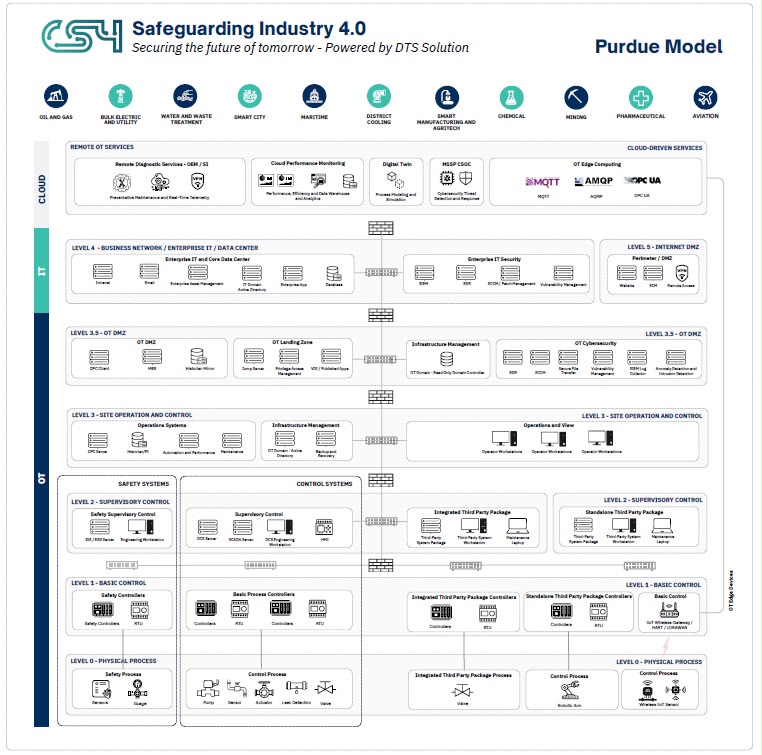
Every CS4 engagement begins with process awareness: mapping the physical process, the control philosophy, the safety functions, and the Purdue-model architecture — including the OT DMZ and the boundary layers between Level 3.5 and Levels 2/1/0 — before a single recommendation is written. A generic IT-derived control applied without that context can be as dangerous to operations as the threat it was meant to stop.
2 · People, Process, Technology — In Harmony, Not In Sequence
CS4 does not treat People, Process, and Technology as a checklist to move through once. They are treated as a single, continuously balanced system, mirroring the E-stop button itself:
PEOPLE | PROCESS | TECHNOLOGY |
Role-based OT cybersecurity training for operators, engineers, and maintenance teams, tailored to operational environments rather than adapted IT programs. When people understand the purpose behind a control, they are more likely to apply it consistently under pressure. | CSMS, governance, policies, and procedures designed to align with ISA/IEC 62443, regulatory requirements, and recognized industry best practices. | Zone-and-conduit segmentation, host-based controls, monitoring, and logging — the enforcement layer for decisions people and process have already defined. |
3 · Build the Reflex, Don’t Just Write the Plan
A written incident response plan is only a hypothesis until it has been tested against a realistic scenario — the same principle behind requiring operators to physically drill on the E-stop button rather than simply reading a manual about it. A procedure that has never been rehearsed is a procedure nobody can execute reliably under real pressure.
That is why table-top exercises (TTX) sit at the center of CS4’s capability-building offering. Each TTX is scenario-built around the client’s actual process, safety systems, and organizational structure, walking cross-functional teams through a realistic OT incident to validate escalation paths, decision ownership, and coordination before an attacker forces the test in production.
18,000+ | 3 | 1st |
sites worldwide run the Triconex safety controller family targeted by TRITON | disciplines CS4 assesses in every engagement — People, Process, Technology | malware framework confirmed to specifically target a safety instrumented system |
The Takeaway
An emergency stop button will never stop a phishing email, patch a vulnerable PLC, or detect lateral movement across a Level 2 network. That was never its job. Its job is to remind everyone who walks past it what OT cybersecurity is for: keeping people, plants, and environment safe when something goes wrong including when what goes wrong is a cyber intrusion.
Technology gives OT environments the ability to see and to act. But it is trained people, operating within a well-designed process, who decide when to act, and it is process that ensures that decision is consistent whether it is 2 p.m. on a Tuesday or 3 a.m. during a shift handover. CS4 exists to build that layer, deliberately, and only after understanding the environment it is meant to protect.
How CS4 Works with Your Environment
CS4 is DTS Solution’s dedicated OT/ICS cybersecurity division. Every engagement starts with understanding your process, not selling a tool.
✓ OT/ICS risk assessments, gap analysis, and Purdue-based architecture reviews
✓ ISA/IEC 62443-aligned CSMS and policy & procedure framework development
✓ Zone & conduit segmentation and OT DMZ design
✓ Role-specific OT cybersecurity awareness and training programs
✓ Environment-tailored incident response table-top exercises (TTX)
Conclusion: Third-Party Risk Is Operational Risk
Service provider cybersecurity is not a side issue in OT environments — it is a direct input into operational resilience and process safety. Every integrator, maintenance contractor, and OEM with access to the Automation Solution is, in effect, an extension of the asset owner’s own security posture, whether that relationship has been formally managed or not.
ISA/IEC 62443-2-4 gives asset owners a structured, internationally recognized way to define, assess, and improve that posture — without needing to write a cybersecurity standard from scratch for every contract.
Used as a practical framework rather than a compliance exercise, ISA/IEC 62443-2-4 turns service provider cybersecurity from an assumption into something asset owners can actually verify.