OT Cybersecuirty and Digital Transformation

When Industry 4.0 Meets the Safety Imperative
Why securing the bridge between your OT environment and the cloud demands far more than an IT mindset
Industrial organizations are modernizing at an unprecedented pace. Cloud analytics, AI-driven predictive maintenance, digital twins, and Industrial IoT promise efficiency gains that boards and shareholders find hard to ignore. The question facing every OT professional today is not whether to embrace these technologies, it is how to do so without compromising the things that matter most: the safety of people, the availability of critical processes, and the integrity of operations.
Pressure to Connect Everything
Across the oil and gas, energy, water, and manufacturing sectors, operational leadership receives the same message from digital transformation programs: connect your plant floor to the cloud, extract your process data, and let AI find efficiencies that your engineers cannot. The commercial logic is compelling. Predictive maintenance models reduce unplanned downtime. Energy optimization algorithms cut costs. Cloud-based analytics allow comparisons across assets and sites that were previously impossible.
The challenge is that OT systems such as Distributed Control Systems (DCS), Programmable Logic Controllers (PLCs), Safety Instrumented Systems (SIS), Emergency Shutdown Systems (ESD), and Fire & Gas Systems (FGS) were never designed with cloud connectivity in mind. They were engineered for one purpose: to perform deterministic, reliable, and above all safe operations, often over decades of continuous service.
When digital transformation programs are designed by IT teams or by technology vendors with limited operational experience, the result is architecture that prioritizes connectivity over safety. That is a trade-off no responsible OT professional should accept.
Safety Remains the Highest Priority
In IT security, the CIA triad, Confidentiality, Integrity, Availability defines the security model. In OT, the priority order is fundamentally different: Safety comes first, then Availability, then Integrity, and Confidentiality last. Any cybersecurity decision that threatens safety or operational continuity is, by definition, the wrong decision regardless of its technical merit.
In an IT environment, patching a vulnerability typically means scheduling a maintenance window, pushing an update, and restarting a service. The business impact is measured in minutes of inconvenience. In an OT environment, patching PLC firmware or applying a security update to a DCS controller can require a full process shutdown, weeks of validation, and coordination across safety, operations, and maintenance teams. In OT, an unexpected process interruption can result in production loss worth millions, equipment damage, safety incidents, or environmental harm. This is why risk-based decision making is not optional in OT cybersecurity, it is foundational.
Safety Instrumented Systems (SIS) and Emergency Shutdown Systems (ESD) carry an additional dimension that many IT security professionals underestimate: their failure modes are not just operational they are potentially fatal. A cybersecurity decision that introduces any uncertainty into a SIS response time, or that could allow remote manipulation of a safety logic solver, is not a cybersecurity risk in isolation. It is a process safety risk. The two disciplines must be managed together, not in parallel silos. OT cybersecurity differs fundamentally from traditional IT security, and every digital transformation initiative must be evaluated through that lens first.
“In OT environments, a security decision that protects the network but threatens process continuity or safety is not a solution. It is a different kind of problem.”
One Size Does Not Fit All
One of the most persistent mistakes in OT security programs is the attempt to apply uniform solutions across diverse operational environments. A refinery with continuous process operations, a water treatment plant with strict regulatory availability requirements, and a discrete manufacturing facility with flexible shift patterns have fundamentally different risk profiles, safety considerations, and operational constraints.
Effective OT cybersecurity begins with understanding what each organization is trying to achieve and what risks they are genuinely willing to accept. That requires a proper OT risk assessment, not a theoretical exercise adapted from IT frameworks, but one that engages process engineers, safety professionals, and operational leadership alongside cybersecurity specialists.
Consider two common scenarios that CS4 encounters across industrial clients:
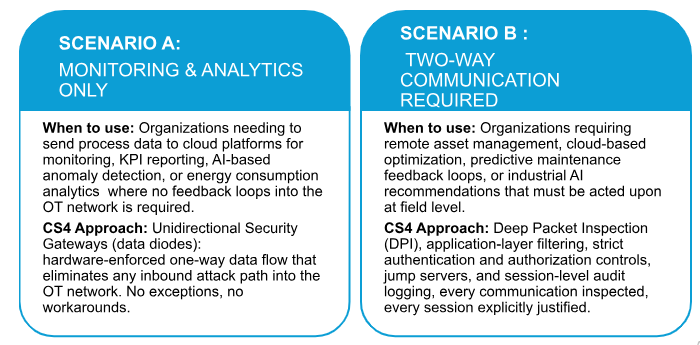
The critical point is that neither scenario is inherently wrong or inherently right. What matters is that the architecture reflects the actual operational requirement, is backed by a documented risk acceptance, and is implemented with the appropriate controls for the communication model in use.
Zoning and Conduits: The Crown Jewel of OT Security Architecture
If there is one principle that underpins every secure OT architecture CS4 designs, it is the concept of security zones and conduits as defined by the IEC 62443 series of standards. This is not simply a compliance exercise. It is the structural logic that determines whether an OT environment can securely accommodate digital transformation initiatives without creating unacceptable operational or safety risks.
Security zones group assets with similar security requirements, trust levels, and operational characteristics. Assets within a zone communicate freely; communication between zones is controlled, monitored, and explicitly permitted through defined conduits. The Security Level assigned to each zone starting from SL-1 through SL-4 which determines the rigor of controls applied.
At minimum, a well-designed OT security architecture should enforce clear separation between the following tiers, aligned to Purdue Model principles
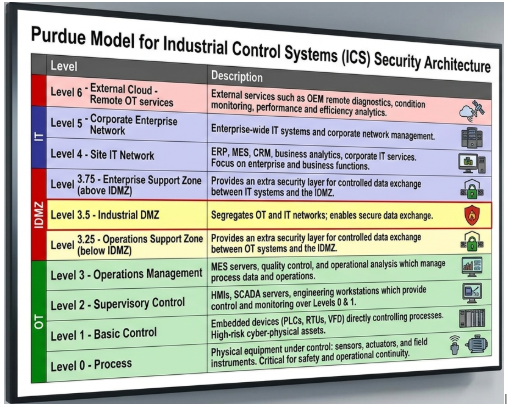
The Industrial DMZ (IDMZ) deserves particular attention. It is not simply a network segment. It is a deliberate architectural construct that ensures no direct communication path ever exists between OT systems and IT Networks/cloud environments. Every data exchange passes through an intermediary such as a historian, a data broker, or a protocol gateway that validates, transforms, and logs the communication. This design pattern is what makes cloud connectivity achievable without compromising OT integrity.
Modern Industrial Protocols and Secure Communication
Legacy industrial protocols were designed for deterministic real-time control, not for security.
- Modbus TCP/IP carries no authentication.
- PROFINET was designed for performance, not encryption.
- DNP3, though more robust, was not conceived with modern threat actors in mind. These protocols continue to operate across millions of industrial assets worldwide and replacing them overnight is neither realistic nor advisable.
What CS4 recommends is a layered protocol strategy, preserving legacy protocols within their appropriate zones while implementing modern secure protocols at zone boundaries and for any communication that crosses into the IDMZ or beyond.
PROTOCOL | USE CASE | SECURITY CAPABILITY | STATUS |
OPC UA | OT-to-IDMZ data exchange, historian feeds, M2M | TLS 1.2/1.3, certificate-based auth, signed/encrypted messages, RBAC | Recommended |
MQTT Sparkplug B | IIoT telemetry, cloud historian feeds, edge computing | TLS, topic-level ACLs, structured payload schema, birth/death certificates | Recommended |
Secure API (REST/HTTPS) | Cloud integration, AI platform feeds, analytics | OAuth 2.0, API keys, mutual TLS, rate limiting, audit logging | Recommended |
Modbus TCP/IP | Legacy PLC/field device communication | None — no auth, no encryption, no integrity validation | Restrict to OT Zone |
DNP3 | SCADA/RTU communication in utilities | Secure Authentication v5 optional — rarely implemented in practice | Compensating Controls Required |
Protocol translation at the IDMZ boundary, converting Modbus or DNP3 into OPC UA or MQTT Sparkplug B before data crosses into the enterprise, is a well-established and highly effective pattern. It preserves existing field-level investments while introducing authentication, encryption, and integrity validation precisely where they are needed: at the trust boundary.
The Role of CS4 in Enabling Secure Digital Transformation
CS4 was built on a simple premise: industrial organizations should not have to choose between operational safety and digital innovation. They should be able to achieve both if cybersecurity is treated as an enabler rather than an afterthought.
The CS4 mission is to bring together deep OT cybersecurity expertise with operational knowledge, the kind that only comes from years working alongside control engineers, process safety professionals, and maintenance teams in real industrial environments. This combination allows CS4 to design architectures that IT security teams alone cannot, because the constraints and priorities of the operational environment are understood from the ground up.
CS4 CORE CAPABILITIES
- OT Cybersecurity Management System (CSMS) development aligned with IEC 62443
- Zone and conduit design
- IDMZ architecture
- Secure remote access frameworks
- OT-specific risk assessments and gap analyses
- Vulnerability management for legacy ICS/OT assets
- Secure cloud integration design
- OT security monitoring and incident response readiness
- Regulatory compliance support (DOE, IEC 62443, NERC CIP, NIS2)
What CS4 does not do is apply template architectures without understanding the operational environment. Every engagement begins with a structured assessment, understanding the asset inventory, the communication flows, the safety architecture, the regulatory context, and the business objectives. Only then is a security architecture designed that reflects the actual risk profile of the organization.
The Future Industrial Environment: Opportunity Requires Foundation
The trajectory of industrial technology is clear. Over the next decade, the operational environments of today will increasingly incorporate AI-driven decision support, digital twins, cloud-based asset optimization, energy management systems, and eventually elements of autonomous operation. These capabilities are not speculative , they are already being deployed at leading industrial organizations worldwide.
What is also clear, from direct experience working across oil and gas, energy, and critical infrastructure environments, is that these capabilities can only deliver their full value when they are built on a secure OT cybersecurity foundation. The organizations that will benefit most from industrial AI and cloud analytics are those that invested in proper zone architecture, secure communication design, and OT risk governance before connecting their plant floors to the cloud, not those that connected first and attempted to retrofit security afterward.
“The future is not about choosing between operational safety and digital transformation. The future is about securely enabling both and that requires treating OT cybersecurity not as a constraint on innovation, but as its most essential foundation.”
Conclusion
CS4 by DTS Solution helps industrial organizations navigate this challenge with the rigor it demands. Combining OT cybersecurity expertise with deep industrial operations knowledge, risk-based methodology, and IEC 62443-aligned architecture design, CS4 supports organizations at every stage of the digital transformation journey, from initial risk assessment through to secure cloud integration and continuous OT security monitoring.
The goal is not compliance for its own sake. It is operational resilience and confidence that your process continues to run safely, reliably, and with integrity, regardless of what the threat landscape looks like today or tomorrow.