Securing AI Integration in OT/ICS Using ISA/IEC 62443: A Risk-Driven Approach for Safe and Reliable Digital Transformation

Artificial Intelligence (AI) is increasingly being introduced into Operational Technology (OT) and Industrial Control Systems (ICS) to enhance production efficiency, optimize energy consumption, and improve asset performance. These benefits are often translated directly into financial gains and operational excellence.
However, AI integration also introduces new cyber risks, particularly when AI platforms rely on internet connectivity, cloud services, or enterprise IT integration. In high-risk OT environments, unmanaged connectivity and uncontrolled data flows can lead to severe consequences impacting safety, availability, and business continuity.
ISA/IEC 62443 provides a structured and practical framework to manage these risks and enable secure AI adoption in OT/ICS.
Unlike traditional IT systems, OT/ICS environments:
When AI systems interact with OT, they are often:
This makes AI
Unlike traditional IT systems, OT/ICS environments:
When AI systems interact with OT, they are often:
This makes AI not just an application, but a cross-domain cyber-physical risk that must be engineered carefully.
ISA/IEC 62443 is structured across multiple layers:
This layered structure makes it well-suited to address AI integration holistically.
AI integration should begin with risk assessment, not technology selection.
Key questions include:
From this point, cybersecurity controls can be designed to reduce risk to an acceptable level, rather than blocking innovation.
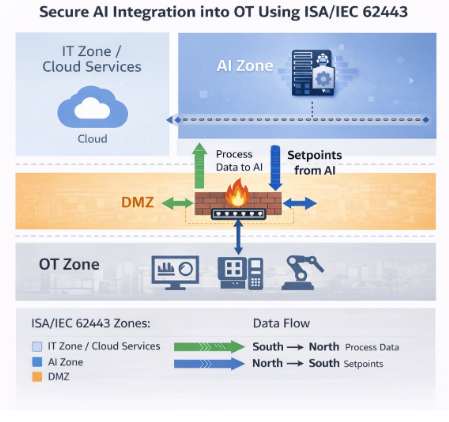
Applying zones and conduits is critical when introducing AI into OT/ICS.
Recommended approach:
Typical data flows:
These conduits must be:
not just an application, but a cross-domain cyber-physical risk that must be engineered carefully.
Several ISA/IEC 62443 Foundational Requirements are especially critical for AI integration:
FR#1 – Identification and Authentication: Ensure only authorized users, services, and AI components can access OT systems.
FR#2 – Use Control: Restrict what AI systems are allowed to do (e.g., advisory vs closed-loop control).
FR#3 – System Integrity: Protect against unauthorized modification of AI models, data, and setpoints.
FR#5 – Restricted Data Flow: Ensure AI communicates only through approved conduits with enforced rules.
FR#6 – Timely Response to Events: Detect abnormal or unauthorized commands, setpoints, or behaviors generated by AI.
These requirements ensure that AI enhances operations without becoming an uncontrolled control element.
Technology alone is not enough, so ISA/IEC 62443-2-1 emphasizes the importance of policies and procedures, including:
Without governance, even technically secure AI deployments can drift into unsafe operating conditions.
CS4 by DTS Solution enables organizations to adopt AI in OT/ICS safely and systematically by:
This ensures AI becomes a controlled, auditable, and resilient capability, not an unmanaged risk.
AI integration in OT/ICS is not just a technology challenge; it is a risk management and engineering challenge.
By applying ISA/IEC 62443 correctly:
The goal is not to block AI but to engineer trust in AI-enabled OT systems.
We offer comprehensive managed OT cybersecurity services through OT lifecycle.