What OT Blueprinting Teaches Us About Visibility, Change, and Resilience in Industrial Control Systems

No structural engineer walks onto a construction site and starts reinforcing walls without the building’s plans. No airline dispatches a flight without the aircraft’s maintenance schematics. Yet across industrial facilities worldwide, cybersecurity teams are routinely asked to secure control systems that have never been fully drawn. Nobody can say with certainty which controller talks to which server, which vendor connection is still open, or which workstation quietly bridges the OT network to the internet.
That gap between what exists on the plant floor and what is documented is where OT incidents live. It is also exactly the gap that a properly built ICS blueprint is designed to close. At CS4, DTS Solution’s OT/ICS Cybersecurity Division, we treat blueprinting as one of the clearest illustrations of how People, Process, and Technology have to work together, because a blueprint isn’t a drawing exercise. It’s a security control in its own right.
What a Security-Grade Blueprint Actually Captures
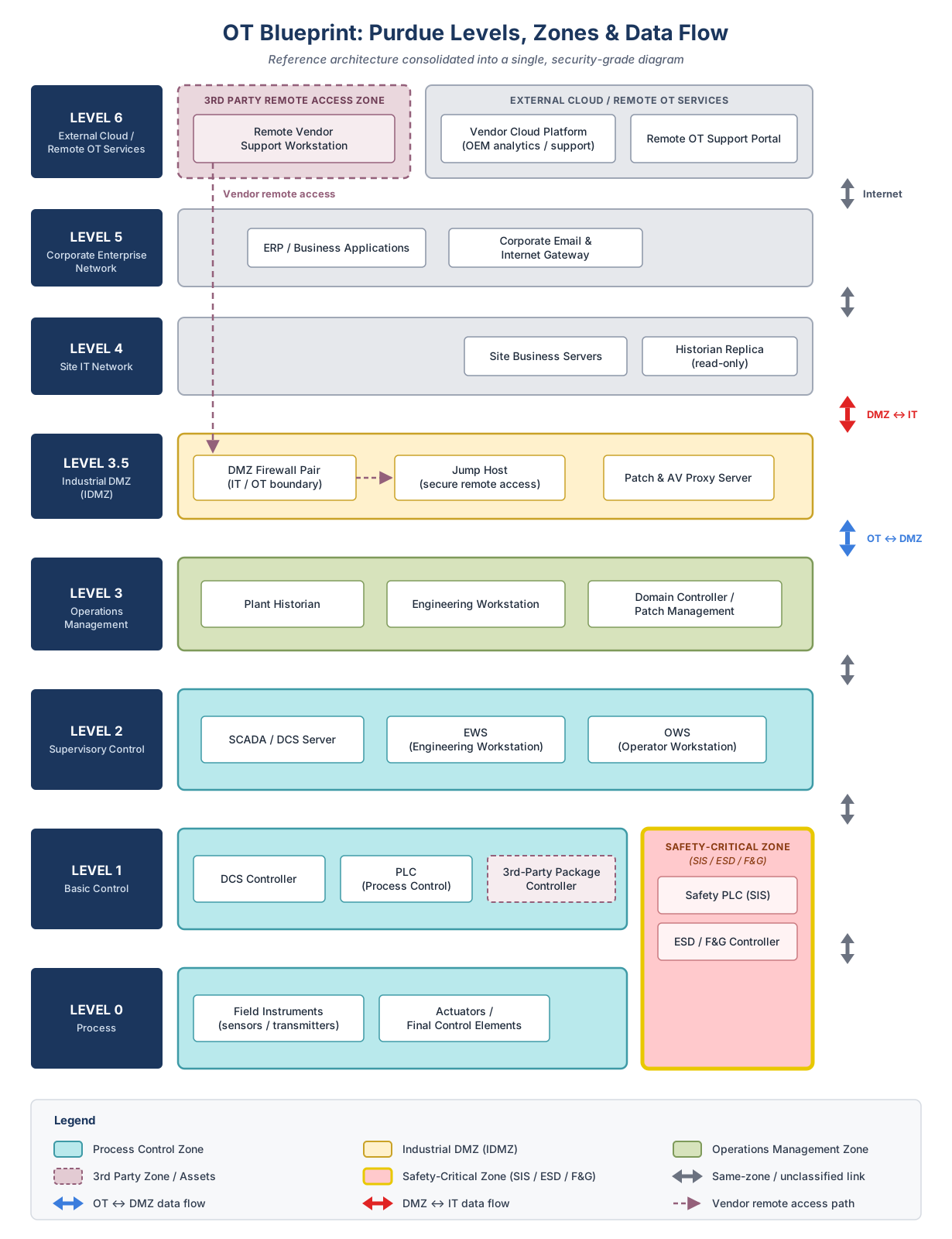
Treating blueprinting as a security discipline rather than a drafting task changes what goes into the drawing. A blueprint built for OT cybersecurity purposes is expected to represent:
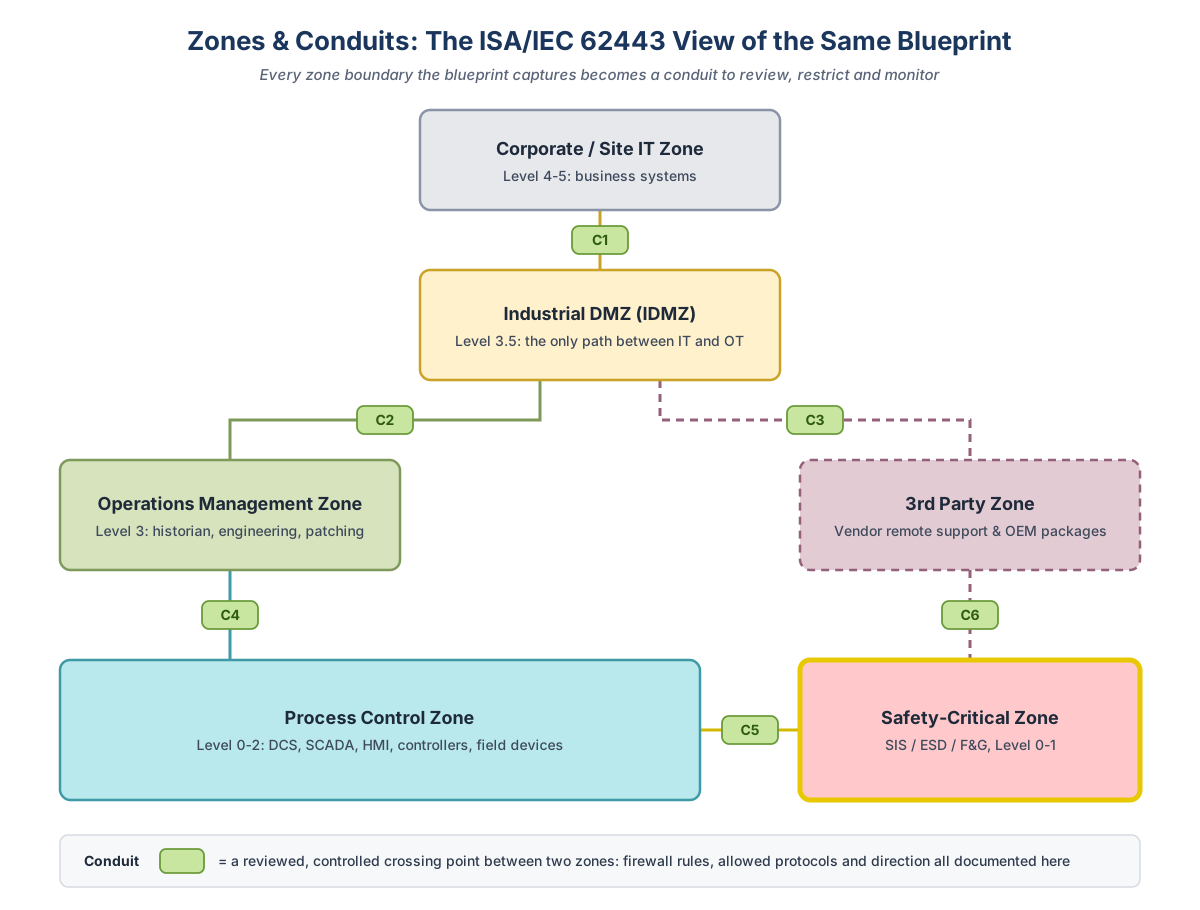
- Zones and conduits, applying the segmentation concepts defined in ISA/IEC 62443, so that trust boundaries are explicit rather than assumed.
- Firewall placement and rule logic, positioned for review rather than buried in a configuration file nobody revisits.
- Data flows between systems, showing not just that two assets are connected, but what is moving between them and why.
- Cloud connectivity and remote access paths, including third-party and vendor access that is easy to forget once commissioning is complete.
- The IT/OT interface, typically realized through an OT DMZ, where enterprise and control-system traffic legitimately meet.
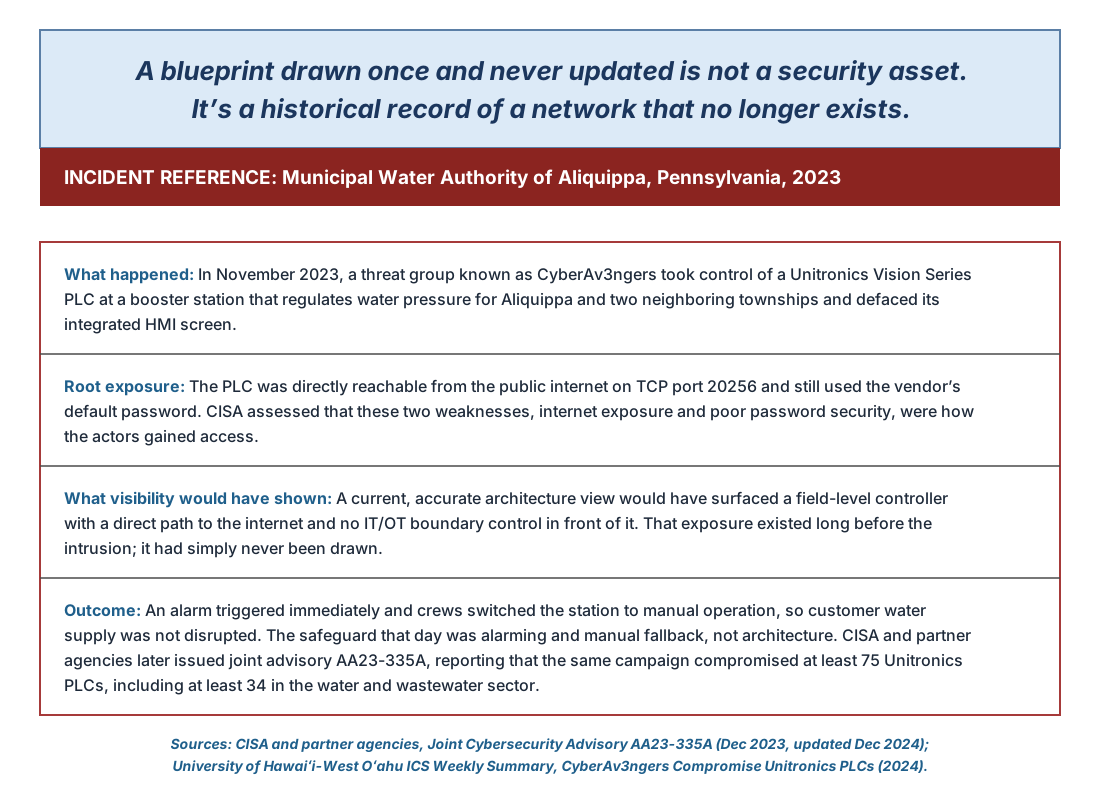
- Any direct connectivity to the internet, which is the single condition that turns a contained OT incident into an exposed one, as Aliquippa demonstrated
1 · Blueprinting Belongs Inside Management of Change
An ICS architecture is never static. New controllers are commissioned, vendors are given temporary remote access, firewall rules are adjusted to support a project, and third-party packages arrive with their own embedded connectivity. Every one of those changes alters the risk picture the blueprint is meant to represent.
That is why blueprinting cannot sit outside the change management lifecycle. Once a modification is implemented, the blueprint must be updated as part of the Management of Change (MoC) approval cycle, the same discipline already applied to process safety changes. A blueprint that is reviewed only during an annual audit is, by definition, out of date for most of the year it is relied upon.
2 · Visibility Without Operational Risk
Gathering this level of detail sounds like it requires installing agents, running active scans, or otherwise touching live production systems. In OT, that risk is real: an active scan can overload a legacy PLC or network module, force a controller into a fault state, or interrupt a control or safety function, which is exactly why operators treat any intrusive activity with caution.
It doesn’t have to. A blueprint can be built using entirely passive, non-intrusive techniques: reviewing existing asset inventories, examining current system architecture documentation for each subsystem, capturing firewall rule sets, and reviewing switch and router configurations. Communication patterns between workstations and servers can be observed and captured without installing or running any software agent on the control system itself. The result is an accurate, editable diagram set built without probing, scanning, or otherwise placing availability or integrity of the industrial control system at risk. You get visibility without adding a single new point of exposure to the environment.
3 · A Living Document, Not a One-Time Deliverable
Once built, the blueprint’s value compounds. It becomes the reference used to assess gaps against recognized frameworks, such as ISA/IEC 62443 zone and conduit requirements and NIST SP 800-82 Rev. 3 guidance for OT security, and to prioritize recommendations based on what the architecture shows, not on generic checklists.
Kept current, it becomes an early warning system in its own right: a new, undocumented path to the internet, an unreviewed vendor connection, or a firewall rule that no longer matches an approved design all become visible the moment someone compares the live environment against the blueprint, rather than being discovered, as in Aliquippa, only after something has already gone wrong.
3Core OT systems typically consolidated: DCS, ESD, F&G | IEC 62443Zone & conduit segmentation standard applied | 0 Agents installed to build the blueprint |
People, Process, Technology: The Blueprinting View
Blueprinting fails whenever it is owned by a single discipline. The blueprint sits at the intersection of people, process, and technology, and it starts decaying the moment any one of the three stops pulling its weight.
- People. The operators and engineers who carry the undocumented knowledge of how the plant is wired together, the assessors who interview them and reconcile the existing drawings against what is really running, and the change owners who are accountable for the blueprint being updated before a modification is signed off.
- Process. Passive capture comes first: asset inventory review, per-system architecture review, and a read of the firewall, switch, and router configurations. After that, the blueprint update becomes a mandatory step in the Management of Change approval cycle, with periodic revalidation of zones and conduits against ISA/IEC 62443 and NIST SP 800-82 Rev. 3.
- Technology. Editable, structured diagrams mapped to Purdue levels rather than flat image exports, built from configuration data the site already holds. No agents, no scanners, and no new hardware introduced into the control system environment.
Read together, the division of labor is straightforward: the site teams supply the truth, the change process keeps it current, and the technology only has to hold it in a form that stays usable.
The Takeaway
Aliquippa was not breached by a sophisticated attacker. It was exposed by an architecture nobody had a current picture of: a controller reachable straight from the internet, still protected by nothing more than its factory-default password. A blueprint maintained as a living security document, reviewed at every change and validated against recognized standards, is precisely the control that turns that kind of exposure from invisible into obvious.
Treat blueprinting as a diagramming task and it decays the moment it’s filed away. Treat it as a security process, owned across people, process, and technology, and it becomes the foundation for every other OT cybersecurity decision you make: architecture hardening, zoning, monitoring, and incident response.
How CS4 Works with Your Environment
CS4 helps asset owners build and maintain an accurate ICS blueprint without putting the availability or integrity of the control system at risk, using passive, non-intrusive techniques from day one.
✓ Asset inventory analysis across DCS, ESD, F&G, and third-party packaged systems
✓ Architecture review for every control system in scope, mapped to Purdue levels
✓ Passive capture of firewall rules, switch and router configurations
✓ Observation of established communications between workstations and servers, with no agents or tools installed on the ICS
✓ Delivery of editable, structured diagrams built for ongoing use, not static, one-time exports
✓ Blueprint integration into the Management of Change approval cycle, so the diagram stays current as the environment evolves
✓ Gap assessment and prioritized recommendations aligned to ISA/IEC 62443 and NIST SP 800-82 Rev. 3
The result is visibility gained without operational risk, plus a living document that keeps paying off long after the first drawing is delivered.
The Takeaway
The tools on both sides changed over the past three years. The underlying logic did not. A gap between a hazard and its permanent fix has always needed a compensating control that is continuous, monitored, and ready to act, a question fire codes settled decades ago for physical protection systems. What changed is the size of the gap and how fast it can be found: the three cases above show AI lowering the research and reconnaissance cost of reaching OT, even where the evidence stops short of a successful physical-process compromise.
The objective was never to pretend every vulnerability can be patched immediately. It is to make sure the unavoidable window between disclosure and permanent remediation does not become an uncontrolled exposure window, and that someone is named as accountable for it the entire time it stays open.
How CS4 Works with Your Environment
CS4, DTS Solution’s OT/ICS cybersecurity division, helps asset owners build this kind of compensating-control program. It is not a promise to eliminate AI-assisted threats outright.
✓ Full asset visibility to Level 1: PLCs, DCS controllers, and SCADA RTUs inventoried against IEC 62443.
✓ Compensating-control design, including virtual patching where appropriate, plus digital-twin or representative test-environment validation before changes reach production
✓ Purdue-based architecture reviews and zone and conduit design for the OT DMZ and secure remote access
✓ AI-assisted OT SOC triage and threat hunting, with every finding reviewed and signed off by an analyst
✓ Consequence-based, crown-jewel risk prioritization for assets carrying safety, integrity, and production risk
✓ OT cybersecurity training and AI-assisted incident-response tabletop exercises
✓ CSMS development aligned to ISA/IEC 62443 across the asset lifecycle